
Email works. Until it really doesn't.
For most florist-to-wholesaler communication - restock orders, weekly standing orders, general availability queries - email is perfectly adequate. It's familiar, it's auditable, and it fits the pace of day-to-day business.
For event orders, email is a single-threaded, unstructured, easy-to-misread medium applied to a problem that requires precision, status tracking, and shared accountability. The friction this creates is one of the most consistent sources of error in the florist-wholesaler relationship - and it's rarely identified as the actual cause.
Why Event Orders Have Different Communication Requirements
A standing restock order is simple: here's what I need, same as usual, send it Tuesday. If something's unavailable, a quick reply and a substitution is usually fine.
An event order for a 150-person wedding is something else entirely.
It might have 25 line items across 12 variety types. It has a fixed event date that cannot move. Some varieties are specialty items with specific lead times. Some need to match a very specific colour palette. The florist has made promises to a client based on those specifics. Any deviation - a substitution, a short quantity, a delivery timing issue - has downstream consequences.
This kind of order requires:
- A structured format that both parties read the same way
- Status visibility throughout the order lifecycle (sent, confirmed, substituted, fulfilled)
- A record of what was agreed, not just what was sent
- A communication channel for the supplier to flag issues before they become problems
Email handles none of these natively.
The "Reply-All Chain" Problem
Here's what event order communication via email actually looks like in practice.
The florist sends an order. The wholesaler replies confirming receipt. A few lines down, they mention one variety is unavailable and suggest an alternative. The florist replies agreeing to the substitution, but adjusts the quantity slightly in the same message. The wholesaler forwards part of the thread to their picking team. At some point the original attachment is not included in the forward.
By delivery day, there are four versions of the order across a thread of eight emails. What was confirmed? Which version of the stem count is the one that was picked against? What happened to the substitution conversation?
No one is at fault in this scenario. The email chain is doing exactly what email chains do. The problem is that it's being used to manage a workflow it wasn't designed for.
The Confirmation Gap
The most expensive communication failure in florist-wholesaler relationships is the confirmation gap: the difference between what the florist believes is confirmed and what the wholesaler has actually committed to.
Florists frequently interpret a reply email as confirmation. Wholesalers frequently interpret a reply email as acknowledgement - "I received your order" is not the same as "I have checked every line against available stock and I am committing to supply each of these items as specified."
This gap is invisible until delivery day. Both parties thought they were operating on the same information. Neither was wrong, exactly. The communication channel just failed to create the shared clarity that event floristry requires.
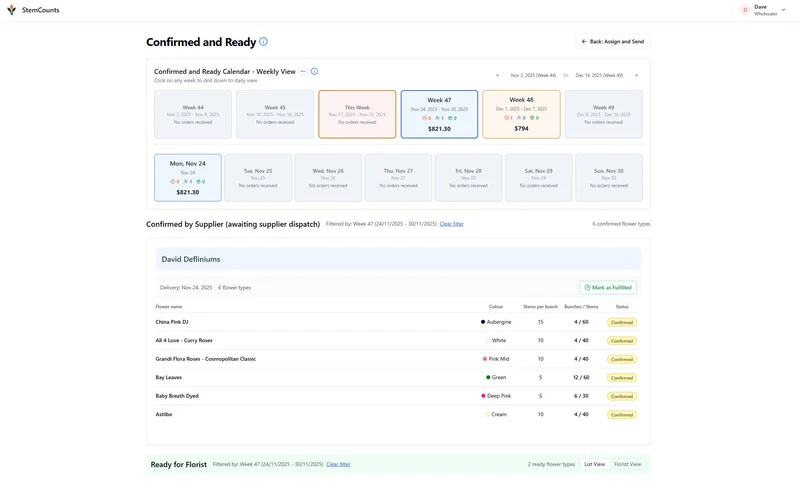
A line-by-line confirmation - where each item gets an explicit "confirmed" or "substitution required" response - would close this gap entirely. Email can technically carry this information. What it can't do is make this the default structure. Someone has to build it, every time, and it's just slow enough that it rarely happens. For a precise breakdown of what confirmation should contain, see what good supplier confirmation looks like in event floristry.
What Florists Lose in the Translation
The florist's stem count lives in a spreadsheet or planning document. To communicate it to the supplier, that data has to be translated - copied into an email, pasted into a message, read out over the phone.
Each translation is an opportunity for a number to change.
Not through carelessness, but through the normal mechanics of manually transferring data: a stem count of 40 becomes 14 through a mistype; "blush" and "ivory" are indistinguishable in a hurried message; "stems" and "bunches" are confused because the florist meant one and the supplier assumed the other.
When the order lives only in the florist's documents, the supplier has no way to verify that what they received is what the florist intended. And when confirmation lives only in the email thread, the florist has no reliable way to verify that what was confirmed matches what was ordered.
What Wholesalers Lose in the Fragmentation
From the supplier's side, managing event orders across email, phone, and WhatsApp during peak season is an intake problem as much as a communication problem.
Orders in different formats require different amounts of time to process. A clearly structured line-item order can be actioned quickly. A paragraph of requirements, or a list without quantities, or a forwarded message with "same as last time" - all require clarification before anything can be done.
That clarification time is not free. At peak season, it multiplies.
Wholesalers also lose order history visibility. When every florist's order history lives in separate email threads, aggregating data - what do they typically order for a winter event? what's their usual substitution preference? - requires manual archaeology. The operational cost of this at peak season is covered in how wholesalers can handle high-volume event season without order chaos.
A Better Framework for Event Order Communication
The shift required here is not about switching tools. It's about treating event order communication as a structured workflow rather than a conversation.
Structure the order as a document, not a message
An event order should be sent as a structured document - line items, not prose. Every variety as a separate entry. Quantities in agreed units. This applies whether you're using email or any other channel. The structure is the thing.
Separate the order from the conversation
Discussions about availability, substitutions, and timing are legitimate. They should happen separately from the order itself - not embedded in the same thread, where they become hard to parse later.
The order is a formal record. The conversation is context. Keep them separate.
Confirm at the line level
Acknowledge this is more work for the supplier. It is, the first time. Over time, line-level confirmation reduces errors and re-work on both sides. The florist gets certainty. The supplier gets fewer urgent calls the morning of delivery.
Build shared records, not parallel ones
The florist has their version of the order. The supplier has their version. These often diverge without either party noticing. A shared order record - where both parties see the same data, in real time - removes the possibility of parallel versions.
Where Shared Order Management Changes the Conversation
The core issue with email as a communication channel for event orders is that it externalises the structure - both parties have to build and maintain it themselves, every time, from scratch.
Platforms built for florist-to-wholesaler order management internalise the structure. The order format is standardised. Status is tracked automatically. Confirmation happens against order lines, not in prose. Both parties have visibility on the same record throughout the order lifecycle.
StemCounts is built around this model. The intent is not to replace the relationship between florist and wholesaler - it's to give that relationship a better operational substrate than a fragmented email thread.
Conclusion
Email isn't going away, and it shouldn't. It's useful for a lot of florist-to-wholesaler communication.
For event orders - complex, high-stakes, fixed-timeline - it falls short in predictable ways: no shared status, no line-level confirmation, no clear version of record, and a structure that has to be rebuilt manually for every single order.
The florists and wholesalers who have moved beyond this point have not done it by using email more carefully. They've done it by treating event order communication as a workflow - with structure, shared records, and confirmation that actually means something.
That's a different problem than "how do we communicate better." It's a systems problem. And systems problems have systems solutions.
Spend your time on flowers, not spreadsheets.
Plan the week's flowers, for the shop or for a wedding, and send them to your wholesaler as one order or event by event.