
There is a specific kind of stress that event florists know well: the feeling of not being entirely sure whether your order is actually confirmed.
You sent it. You received a reply. But was that a confirmation, or was it an acknowledgement? Did they check every line, or did they just forward your email to the picking team and move on?
Most of the time, nothing goes wrong. But when it does - a variety that's unavailable, a quantity that was misread, a substitution that wasn't flagged - it's almost always traceable back to this ambiguity. The florist believed the order was confirmed. The supplier considered it received.
The florist supplier confirmation process in event floristry is the step that most commonly breaks down, and the most commonly overlooked. It connects directly to how florist-to-wholesaler communication works for event orders.
The Problem With How Confirmation Currently Works
In most florist-wholesaler relationships, an order is "confirmed" when the supplier replies to the email. Sometimes it's a brief reply - "thanks, we'll get this sorted for you." Sometimes it's silence, and the florist follows up.
In neither case does the florist actually know:
- Whether each variety has been checked against available stock
- Whether any lines are unavailable or short
- Whether the quantities were read correctly
- Whether substitutions are being considered without being mentioned
This is the confirmation gap. The florist's mental model is "order confirmed, I can plan around it." The supplier's mental model may be "order received, we'll handle it when we get to picking."
These are not the same thing. And in event floristry, the difference matters.
What "Confirmed" Actually Needs to Mean
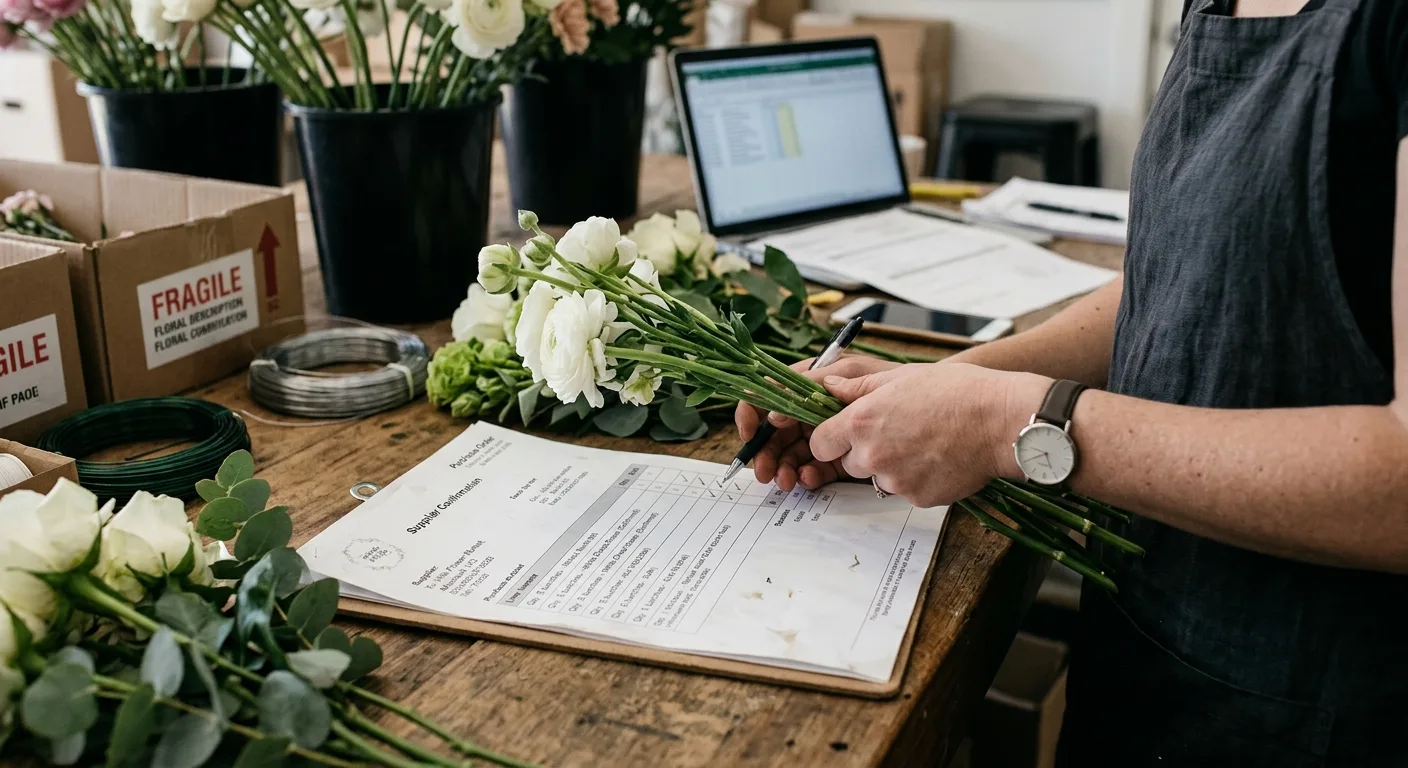
Good supplier confirmation in event floristry has a specific definition: each line item in the order has been checked against available stock, and the supplier has committed to supplying each item as specified - or flagged where they cannot.
That's it. It doesn't need to be complex. But it does need to be specific.
A confirmation that meets this standard includes:
For each order line:
- The variety and quantity as the florist submitted it
- A status: confirmed / unavailable / substitution proposed
- If substitution: what is being proposed, at what quantity
For the overall order:
- Confirmed delivery date and window
- Any items that are still pending stock confirmation (and when that will be resolved)
This information takes the supplier a few minutes to compile. The clarity it provides to the florist is worth significantly more than those few minutes - in reduced stress, reduced re-work, and reduced risk of a delivery-day crisis.
The Difference Between "Received," "Acknowledged," and "Confirmed"
It's worth being precise about these terms, because they're used interchangeably in practice but represent meaningfully different states.
Received: The order arrived at the supplier. They have it. No action has been taken yet. "Thanks, got your order" is receipt.
Acknowledged: The supplier has read the order and flagged it for processing. No stock check has been done. "Looks good, we'll get onto it" is acknowledgement - it sounds like more than receipt, but functionally it's the same.
Confirmed: Each line has been checked against available stock. The supplier is committing to supply. Any deviations are disclosed.
Most florists receive acknowledgements. They hear "confirmed." This is where the gap lives.
Why Verbal Confirmations Create Problems
Phone confirmations and verbal agreements feel more reliable than email because they involve a human voice and immediate back-and-forth. In practice, they create more ambiguity, not less.
A verbal confirmation is not a document. It exists in two people's memories, which is two opportunities for the detail to be remembered differently. It cannot be checked at 5am on a delivery morning. It cannot be forwarded to a driver. It cannot be used to resolve a dispute about what was agreed.
This is not about distrust. It's about the nature of high-stakes planning. Event floristry has fixed timelines, and the cost of a miscommunication compounds as delivery day approaches. A written confirmation - even a simple one - creates a shared record that removes the "I thought you said" problem entirely.
Substitutions: Before, Not During
The most damaging time to learn about a substitution is when the delivery arrives.
At that point, there are no good options. You either use the substituted variety and hope the design holds, you refuse the delivery and go short, or you spend the next two hours calling every other supplier in the city.
None of these is acceptable for a large event.
Good substitution handling requires a different timeline entirely:
The moment a variety looks risky - a supplier should be communicating this proactively. Not when they pick the order. Not when the driver loads the van. When they know.
The substitution conversation should happen before the order is finalised where possible, or at minimum days before delivery. The florist needs to assess whether the substitute works for the design, communicate any changes to the client if necessary, and adjust quantities if the substitute has different stem characteristics.
The substitution agreement should be in writing. Both parties should have the same record: what was ordered, what is being substituted, why, when it was agreed.
This is the standard for large events. It's not what usually happens - but it's what should happen.
Building a Confirmation Process That Actually Works
The following is a practical framework for event florists who want to move from "I think it's confirmed" to "I know it's confirmed."
Step 1: Send a structured order
A line-item order is easier to confirm line by line than a prose description. If your order is clear, the confirmation will be clearer. The format you use for ordering directly affects the quality of confirmation you'll receive.
Step 2: Set a confirmation expectation upfront
When you send the order, specify what you need back: "Please confirm each variety individually and flag any substitutions or availability issues." This isn't rude - it's professional. Most suppliers will respect the clarity.
Step 3: Set a confirmation deadline
"Can I have confirmation by [day]?" gives the supplier a clear target and gives you enough time to resolve any issues before delivery. For a Friday delivery, a Tuesday confirmation deadline leaves three days to manage problems.
Step 4: Chase proactively, not reactively
Don't wait until Wednesday to realise you never got a confirmation for Friday's event. Build a check into your weekly process: every order that's been sent should have a confirmation by a defined point. If it doesn't, chase it.
Step 5: Capture substitutions in your order record
When a substitution is agreed - whether by email, phone, or in person - document it against the order line immediately. "Blush ranunculus substituted with white lisianthus, 40 stems, agreed [date]." This is the record you refer to if anything is disputed at delivery. For a complete guide to managing substitutions before delivery day, see managing flower substitutions on event orders.
What Line-Level Confirmation Looks Like in Practice
Here's a simple example of what a good supplier confirmation covers for a single order line:
Garden roses, blush, 60 stems - Confirmed Eucalyptus, silver dollar, 30 stems - Confirmed White peonies, 40 stems - Unavailable. Proposing white ranunculus as substitute, same quantity. Please advise. Lemon cypress, 20 stems - Confirmed
This takes the supplier five minutes. It gives the florist everything they need to plan with certainty. It surfaces the problem (the peonies) at a point where it's still solvable.
This is what good looks like. It's not complicated. It's just specific.
Where Structured Order Workflows Change the Default
The reason this level of confirmation is rare isn't that suppliers don't want to provide it or florists don't want to receive it. It's that the current infrastructure - email threads, phone calls, WhatsApp messages - makes it slow to produce and hard to maintain.
A structured order workflow changes what the default looks like. When an order is submitted through a platform that supports line-level confirmation, the structure is built in. The supplier is prompted to confirm each line. The florist receives a confirmation against their specific order record. Substitutions are flagged in context, not buried in a thread.
StemCounts is built around this model - because the problem isn't that florists and wholesalers don't know what good confirmation looks like. It's that the tools they're currently using make it genuinely difficult to produce.
Conclusion
Good supplier confirmation in event floristry is not a high bar. It requires: each line checked against stock, deviations disclosed, substitutions handled before delivery day, and a written record that both parties hold.
What makes it rare is not complexity but process. Email and phone-based confirmation workflows don't create the structure that makes this easy. They require both parties to build that structure manually, every time.
The florists who consistently achieve certainty about their orders - who genuinely know what's coming on delivery day - have either built very disciplined manual habits around this, or they've moved to a system that makes line-level confirmation the path of least resistance.
Either way, the starting point is the same: being precise about what "confirmed" actually means, and refusing to accept anything less.
Spend your time on flowers, not spreadsheets.
Plan the week's flowers, for the shop or for a wedding, and send them to your wholesaler as one order or event by event.