In wholesale flower supply, price is what gets you the first order. Experience is what gets you the tenth.
Event florists - particularly those running consistent volumes of weddings and functions - are high-value, high-loyalty clients when the relationship works. They order regularly, they plan in advance, and they know exactly what they need. They don't require hand-holding. They require reliability.
When that reliability is missing, they leave. And the uncomfortable reality of flower wholesaler florist relationships is that most of the attrition isn't about price at all. It's about order experience: wrong stems, slow confirmation, silent substitutions, poor communication on availability issues.
Why Reliability Matters More Than Price for Event Florists
Retail florists make purchasing decisions differently from event florists. A retail florist can adapt mid-week if something isn't available. They can substitute on the floor, adjust the display, move on.
An event florist cannot. Their commitments are locked in writing with clients, often months in advance. The flowers they order on Monday are for a wedding on Saturday. There is no mid-week adjustment.
This fixed-timeline reality means event florists carry a different risk profile than retail clients. When a supplier gets an order wrong - wrong variety, wrong quantity, wrong grade - the consequences are not inconvenient. They are potentially catastrophic for the florist's relationship with their client.
Because the stakes are high, event florists are intensely sensitive to reliability. A single significant error can end a relationship that took years to build. And because they talk to each other - at industry events, in online communities, through referral networks - a wholesaler with a reputation for poor order accuracy will feel the effect beyond the single florist who had a bad experience.
The Top Reasons Event Florists Switch Wholesalers
If you ask event florists why they've changed suppliers, the answers cluster around a few consistent themes:
Wrong orders fulfilled without notification. The supplier substituted a variety without telling anyone. The florist found out when the delivery arrived the morning of the event.
Confirmation that wasn't confirmation. The supplier said "confirmed" - meaning "received." The florist heard "confirmed" as in "every line checked and committed." The mismatch created a problem that couldn't be solved in time.
Slow or absent communication on problems. A variety was unavailable. The supplier knew before picking day but didn't flag it. By the time the florist found out, there were no good options.
Inconsistent fulfilment quality. Not every order was wrong. Maybe one in ten had an issue. That's enough. An event florist can't build their planning process around a one-in-ten error rate.
None of these are about price. All of them are about the operational experience of ordering from that supplier.
What "Easy to Order From" Means in Practice
The florists who are most loyal to a particular wholesaler almost always describe the relationship the same way: it's easy. The orders go in cleanly, the confirmations come back promptly, problems get flagged early and resolved quickly.
Unpacking that into specifics:
Consistent order intake. The wholesaler accepts orders in a structured format and processes them consistently. There's no ambiguity about whether the order was received correctly.
Responsive confirmation. Orders confirmed within a defined window, not when someone gets around to it. Line-level confirmation, not a blanket "looks good."
Proactive communication on issues. When something isn't available, the florist hears about it immediately - with an alternative offered, not just a problem stated.
Reliable fulfilment. What was confirmed is what arrives. Not approximately. Not mostly.
Quality consistency. Grade specifications are respected. "Premium" means the same thing every week.
This is a high bar. But it's the bar that generates loyalty and referrals. Florists who experience this consistently don't look for alternatives - they don't need to.
The Value of Consistent, Structured Order Intake
One of the highest-leverage improvements a wholesaler can make to their florist experience is standardising order intake.
This benefits the wholesaler as much as the florist:
- Consistent intake format means faster processing - staff aren't decoding different formats for every florist
- Line-item orders reduce clarification calls - the information is there
- Structured orders are easier to check against stock systematically, which means better confirmation accuracy
And it benefits the florist:
- Their order is processed correctly the first time
- There's less back-and-forth, which saves them time
- The confirmation they receive is reliable, because the intake process that produced it was reliable
The ask is simple: work with your florist clients to settle on a standard order format. Share it. Make it easy for them to use. The upstream consistency pays dividends through the entire order cycle. For the operational detail of how intake standardisation works at peak volume, see how wholesalers can handle high-volume event season without order chaos.
Proactive Communication as a Retention Strategy
The most costly communication failure in a wholesale relationship is the silent problem: the variety that's going to be short, the substitution that's already been decided, the delivery delay that's already happening - and the florist doesn't know yet.
Every hour that passes between the supplier knowing about a problem and the florist hearing about it is an hour of lead time lost. For large events, lead time is the only resource that makes problems solvable.
A supplier who calls Monday afternoon to say "I'm short on your white peonies, here's what I'm proposing instead" is a supplier whose florist clients will tolerate the occasional problem. The problem was flagged. An alternative was offered. The florist has time to decide.
A supplier whose florist finds out about the peony shortage when the van arrives at 6am on Saturday is a supplier looking for a new client by the following week.
The operational habit this requires is simple: when you know about a problem, tell the florist immediately. Not when you finish picking. Not after the delivery is loaded. When you know. The confirmation gap that drives most of these situations is covered in detail in what good supplier confirmation looks like in event floristry.
How Order History Benefits Both Parties
A wholesaler who maintains good records of what each florist orders over time has a significant operational and commercial advantage.
For inventory planning: Consistent florists are predictable florists. If you know that a particular florist runs eight weddings per month through October, you can plan your buying accordingly. Seasonal stock buys become more accurate. You're not buying blind.
For relationship management: When a florist calls to place an order for an event similar to one from last year, being able to reference what they ordered previously - and how it worked - is a genuine value-add. It reduces their planning time and signals that you're paying attention.
For the florist's planning: Some platforms and suppliers now make historical order data available to florists directly. A florist who can pull up last year's stem count for a returning client - from within the ordering interface - is saving hours of work. That convenience is sticky.
The Compounding Effect of a Good Relationship
The financial case for investing in florist retention is straightforward.
Event florists who trust their supplier order predictably, plan in advance, and don't require constant hand-holding. They are low-cost accounts to service once the relationship is established. They also refer other florists - the floristry community is smaller and more networked than it appears from the outside.
A wholesaler with 20 loyal event florist clients, each ordering consistently week-to-week, has a revenue base that is largely self-sustaining. Each of those clients represents years of relationship-building. Losing one to a competitor over a preventable experience failure is not just the loss of that client - it's the loss of future referrals and the potential beginning of a reputational issue.
The cost of a strong order experience - structured intake, reliable confirmation, proactive communication - is almost entirely operational. The return, in retention and referral, is multiples of that cost.
Where Shared Order Management Improves the Relationship
Much of the friction in the wholesale florist relationship originates from the same source: both parties working from different records of the same order, with no real-time visibility into each other's state.
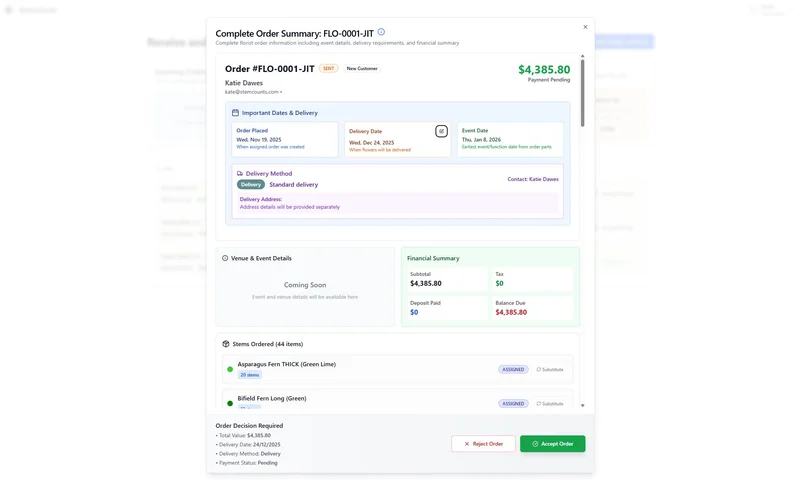
A shared order management platform - where the florist submits a structured order and the wholesaler confirms against the same record - removes the fragmentation that causes most of the problems above. The florist's intent and the supplier's commitment live in the same place. Substitutions are flagged in context. Confirmation is line-level by default.
StemCounts is built around this model specifically because the operational friction between florists and wholesalers is largely a shared-record problem, not a communication problem. When both parties are working from the same order record, in real time, the nature of the relationship changes.
Conclusion
Florist retention for wholesale flower suppliers is not primarily a pricing problem. It's an experience problem.
The event florists who stay with a supplier long-term do so because ordering from that supplier is reliable, clear, and low-friction. Problems get flagged early. Confirmations mean what they say. Orders arrive as specified.
Building this experience requires operational investment, not discounting. Standardised intake, proactive communication, line-level confirmation, consistent fulfilment. These are the components of a supplier relationship that generates loyalty - and the loyalty of even a handful of high-volume event florists compounds into a genuinely valuable, stable account base.
The florists are looking for a reason to stay. Give them one.
Give your florists an easier way to order.
Florists plan and send their orders in StemCounts. You get every order in one list, ready to confirm line by line. Free for wholesalers.