
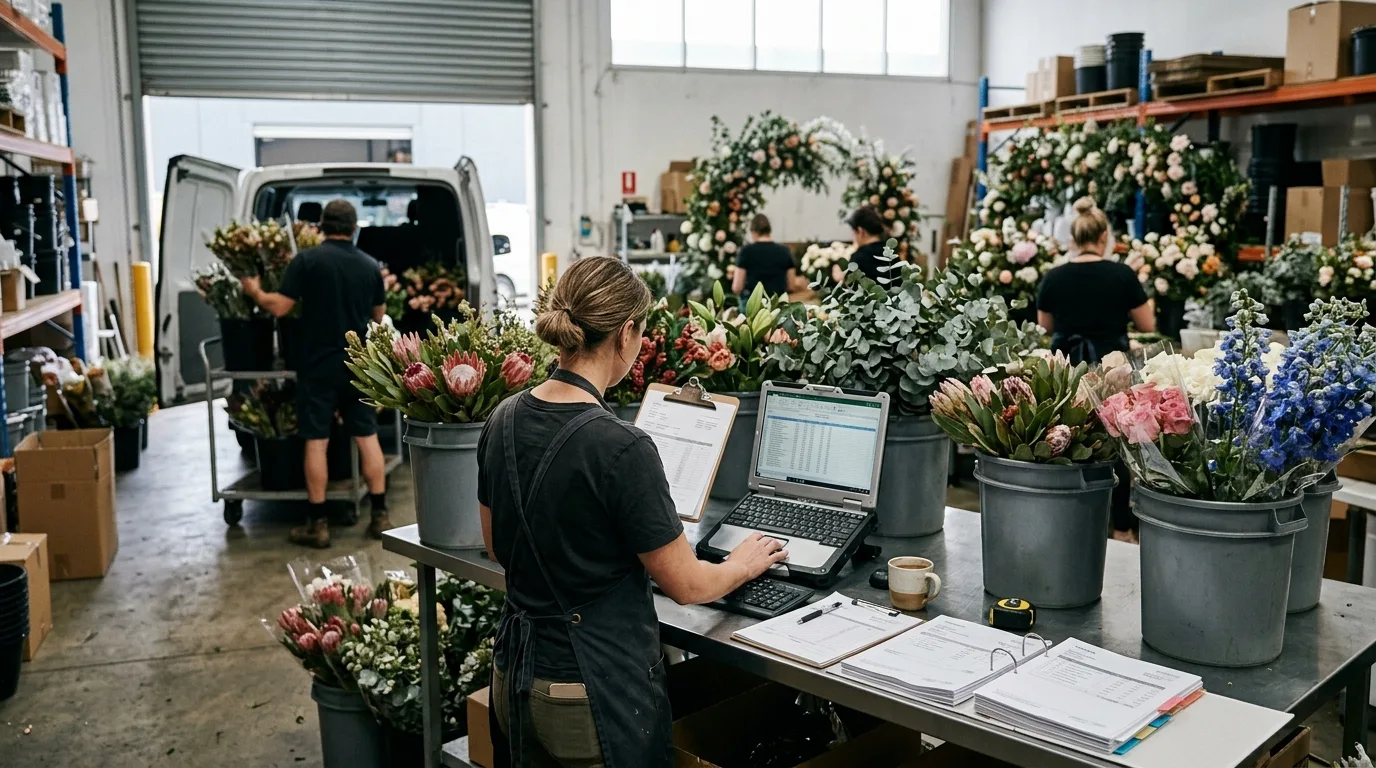
There's a growth trap in event floristry that catches a lot of talented florists at roughly the same stage: somewhere around six to eight events per month, the business stops feeling manageable.
The creative work is going well. The client roster is growing. The events are getting bigger and more ambitious. But behind the scenes, the admin is expanding faster than the revenue. More events means more orders to plan, more suppliers to coordinate, more confirmations to chase, more client changes to track.
The instinctive response is to hire someone. An admin assistant, a studio coordinator, a second florist who can handle the paperwork. And sometimes that's the right call.
But for a lot of florists, the admin burden isn't a staffing problem. It's a systems problem. And hiring before fixing the system means the new hire spends most of their time managing the same broken process - just with more hands.
Where Admin Time Actually Goes
Most event florists who feel overwhelmed by admin underestimate how much of it is structural - built into the way the business currently operates - rather than genuinely necessary.
A realistic breakdown of where admin time disappears for a florist managing eight events per month:
Order preparation: Translating design briefs into stem counts, building supplier orders, aggregating quantities across events. Often done manually, often more than once due to client changes.
Supplier communication: Sending orders, chasing confirmations, resolving ambiguous replies, managing substitution conversations, following up on unavailable items.
Status tracking: Keeping track of which orders are sent, which are confirmed, which have open questions, which are ready for delivery. Usually done through memory, email flags, and informal notes.
Re-work after errors: Correcting stem count mistakes, reordering short-supplied varieties, resolving discrepancies between what was ordered and what arrived.
Client updates: Communicating changes to the client that originated from the supplier side - substitutions, availability issues, timing adjustments.
The first two categories - order preparation and supplier communication - are the biggest consumers of time, and both are heavily affected by the quality of the underlying system. With a tight process, they're manageable. Without one, they scale faster than the revenue.
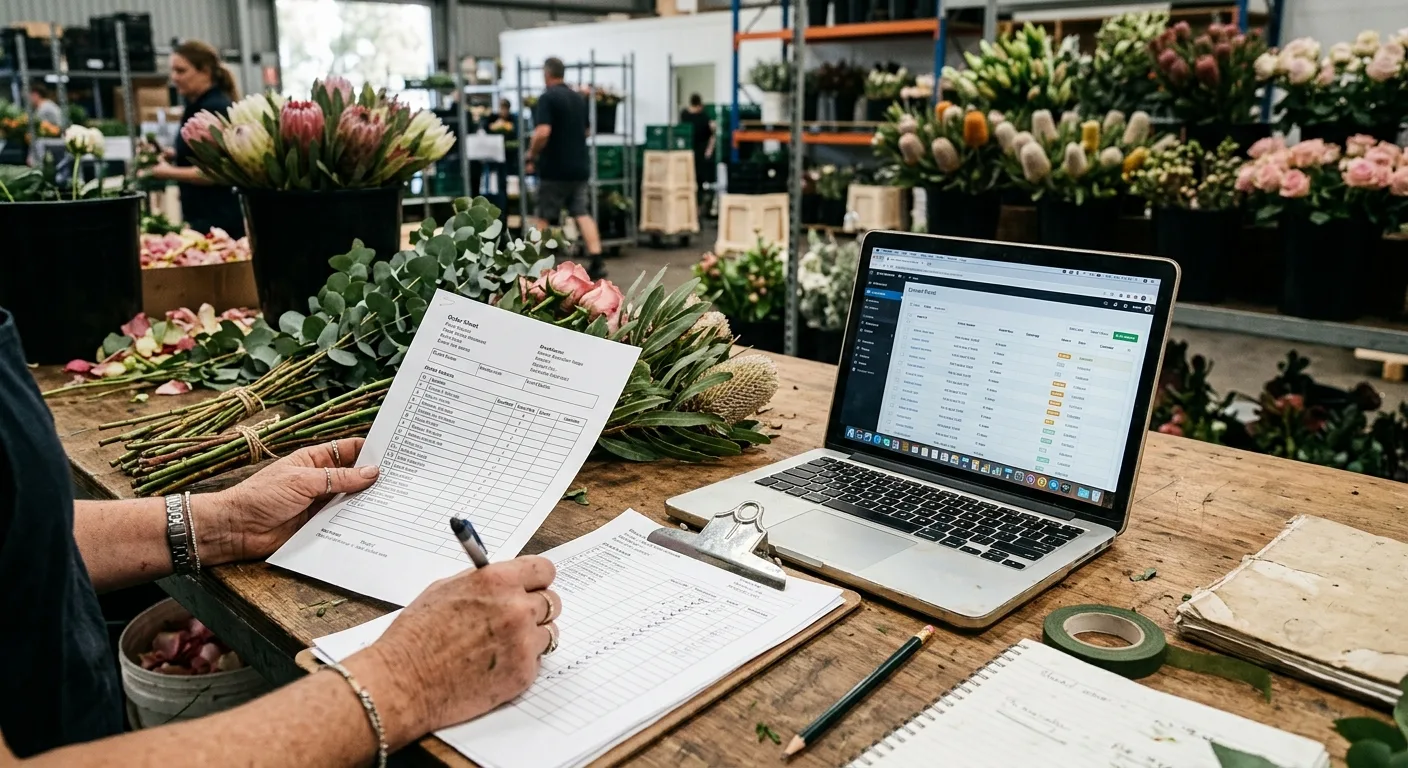
The Bottleneck That Appears Around 6-8 Events Per Month
Below this volume, a florist can hold a lot in their head. They know every event, every order status, every supplier conversation. The overhead is high but the business is small enough that it works.
At six to eight events per month, the mental load exceeds what one person can reliably manage. Events start bleeding into each other. Order details from one event get confused with another. A client change that should take five minutes creates 30 minutes of re-work because the downstream implications weren't tracked.
This is the point where most florists either hire someone or slow their growth deliberately to stay within what they can manage. The third option - fixing the system - is often overlooked because it feels less immediate than the problem in front of you.
The Difference Between Working Harder and Building Systems
Working harder solves the capacity problem for a few more months. Building systems solves it structurally.
The distinction is this: a system produces the same output regardless of how tired you are on a given Wednesday. A willpower-based approach doesn't.
For a floristry business, the systems that have the highest leverage on admin time are:
Standardised order templates
A standardised order format - one that covers every field your supplier needs, in a consistent layout - eliminates the "compose from scratch" step every time you place an order. It also reduces the back-and-forth clarification that inconsistent orders generate.
More importantly, it means the person doing the ordering doesn't need to carry the format in their head. The template does that.
Historical order data
The fastest way to build a stem count for a returning client is to start from the previous year's order. The fastest way to build one for a new client with a similar brief is to start from a comparable event.
Most florists who've been operating for several years have this data - it just lives in spreadsheets, email archives, or memory, where it's not easily retrievable. Making it accessible is not a glamorous improvement, but the time it saves compounds over a full season.
Aggregated weekly ordering
Placing one consolidated supplier order for all events in a given week - rather than individual orders per event - reduces your supplier communication overhead significantly. One order, one confirmation cycle, one delivery coordination.
This requires visibility across all events simultaneously, which is harder to achieve with per-event spreadsheets than with a centralised planning view. The full framework for building a weekly ordering cycle is in weekly flower order planning for event florists.
Explicit status tracking
Not in your head. Not in email flags. An explicit record - per order line - of what's been sent, confirmed, substituted, and fulfilled. The time saved on "wait, did I confirm that?" moments adds up quickly.
Practical Steps to Reclaim Admin Time Without a New Hire
Step 1: Time your current admin for one month
Before you can fix the problem, you need to know where the time is actually going. Log it roughly - order prep, supplier comms, status tracking, re-work. The pattern is usually more concentrated than people expect. Most of the overhead for florists at this stage traces back to spreadsheet-based workflows - see why spreadsheets are costing florists time on wedding orders.
Step 2: Identify your highest-impact process fix
Not every improvement is equal. If 40% of your admin time is going to re-work after errors, fixing order accuracy is more valuable than optimising your email template. Start with the biggest cost.
Step 3: Build a standard order template
It should cover every field your supplier needs. Share it with your supplier so they know what to expect. Use it for every order. This alone reduces order preparation time and clarification overhead.
Step 4: Move to weekly consolidated ordering
Review all upcoming events on a fixed day each week (Monday or Tuesday works well). Aggregate stem requirements across events. Place one order with your supplier. Build this into a consistent rhythm.
Step 5: Create an explicit confirmation record
Whether it's a column in a spreadsheet or a separate document, every order line should have a confirmation status that's visible at a glance. "Is this confirmed?" should take five seconds to answer, not five minutes of email archaeology.
Step 6: Use historical data as a starting point
After every event, file the final stem count somewhere retrievable. When a similar event comes up, start from that record. It won't be perfect but it's faster and more accurate than starting from zero.
When It Does Make Sense to Hire
None of this means never hire. Growth beyond a certain point genuinely requires more people.
But the value of fixing your systems first - before hiring - is twofold:
- You hire at a higher threshold. The systems handle more of the volume before the bottleneck reappears.
- When you do hire, the new person steps into a defined role with documented processes, not a vague "help with stuff" function. They become productive faster and make fewer errors.
A hire into a broken system inherits the chaos. A hire into a working system extends the capacity.
Where Workflow Tools Change the Equation
The manual implementation of the steps above is achievable. It requires discipline and consistent execution.
Where platforms like StemCounts change the equation is in making the structure the default. Event-level stem planning, automatic aggregation across the week, supplier order workflows, and confirmation tracking are all built into the workflow - not bolted on through spreadsheet maintenance.
The result is that the discipline required to run a tight process decreases. The structure is there whether or not you're operating at peak capacity. Which means it holds up during the busy periods, when it matters most.
Conclusion
Scaling a floristry business without proportionally scaling admin overhead is a process problem, not a staffing problem. The florists who manage it well haven't found someone to take the admin off their hands - they've built systems that generate less admin in the first place.
Standardised templates. Aggregated weekly ordering. Explicit status tracking. Historical data that's actually usable.
None of it is complicated. All of it requires commitment. And the payoff - more design time, more client time, more capacity - is the thing that makes growth actually feel like growth.
See it in action
Managing multiple events without spreadsheets or copy-paste admin.
Spend your time on flowers, not spreadsheets.
Plan the week's flowers, for the shop or for a wedding, and send them to your wholesaler as one order or event by event.