Most event florists don't have a weekly flower order planning system. They have a weekly flower order planning habit - and those are different things.
A habit is what you do when you have enough time and mental bandwidth. A system is what happens regardless. The distinction matters because event floristry is seasonal, variable, and frequently overwhelming. The weeks when you most need a reliable process are exactly the weeks when a habit breaks down.
A proper weekly planning rhythm isn't complicated to build. And once it's running, it changes the texture of the week in ways that go beyond just getting the orders in on time.
Why Reactive, Per-Event Ordering Is the Default
Most florists start their careers doing retail work, where ordering is continuous and relatively simple. You order what you need when you need it. Variety matters, but the stakes per order are lower.
When event floristry volume grows, many florists carry this reactive approach with them. An event comes up, they build a stem count, they send an order. The next event comes up, same process.
This works at low volume. At four, five, six events in a single week, it starts to break:
- You're sending fragmented orders to the same supplier multiple times in the same week
- Deliveries are scattered across different days, each requiring time to receive and check
- You have no holistic view of what you're ordering - and no ability to catch duplicate or conflicting requirements across events
- Each order is a separate communication cycle with its own confirmation overhead
The per-event approach is not wrong for one event. It's just not designed for eight.
What a Weekly Planning Rhythm Actually Looks Like
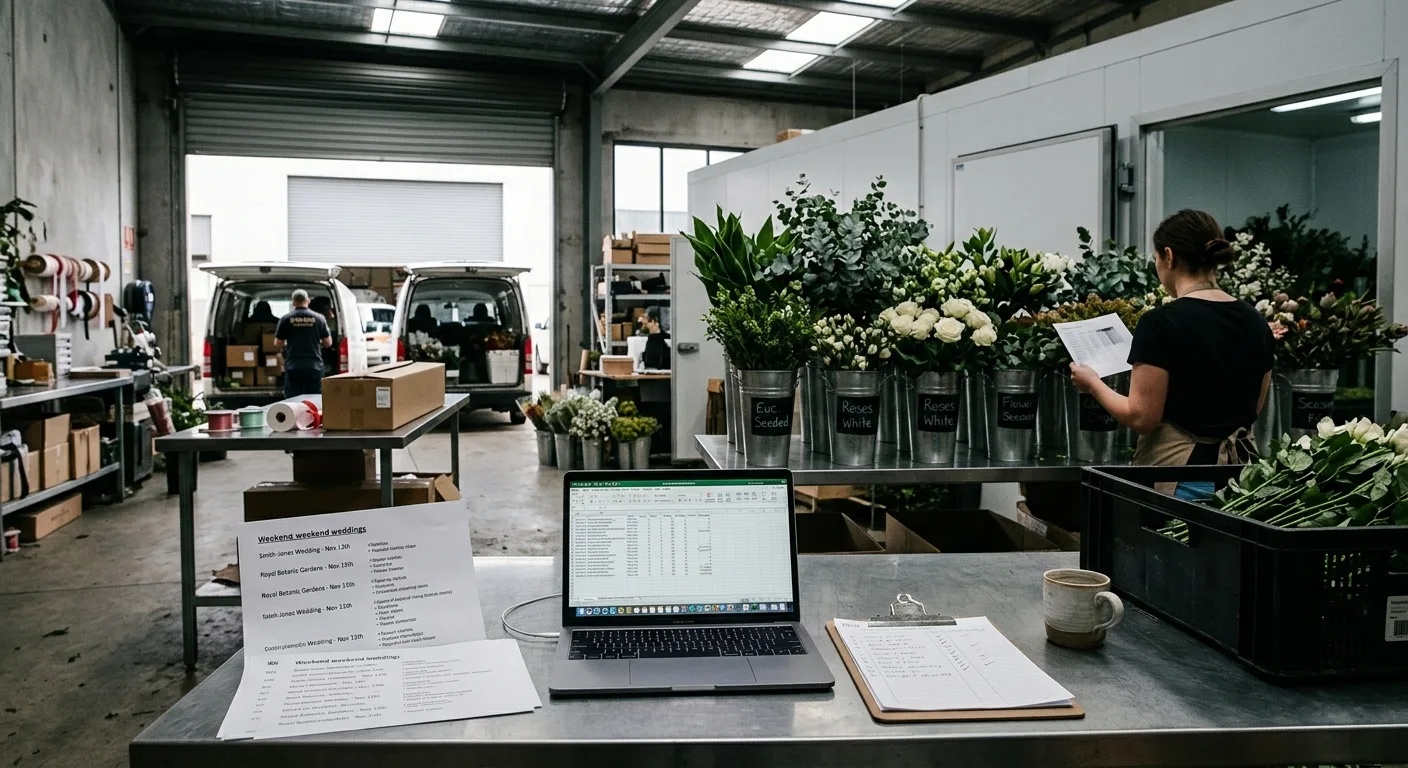
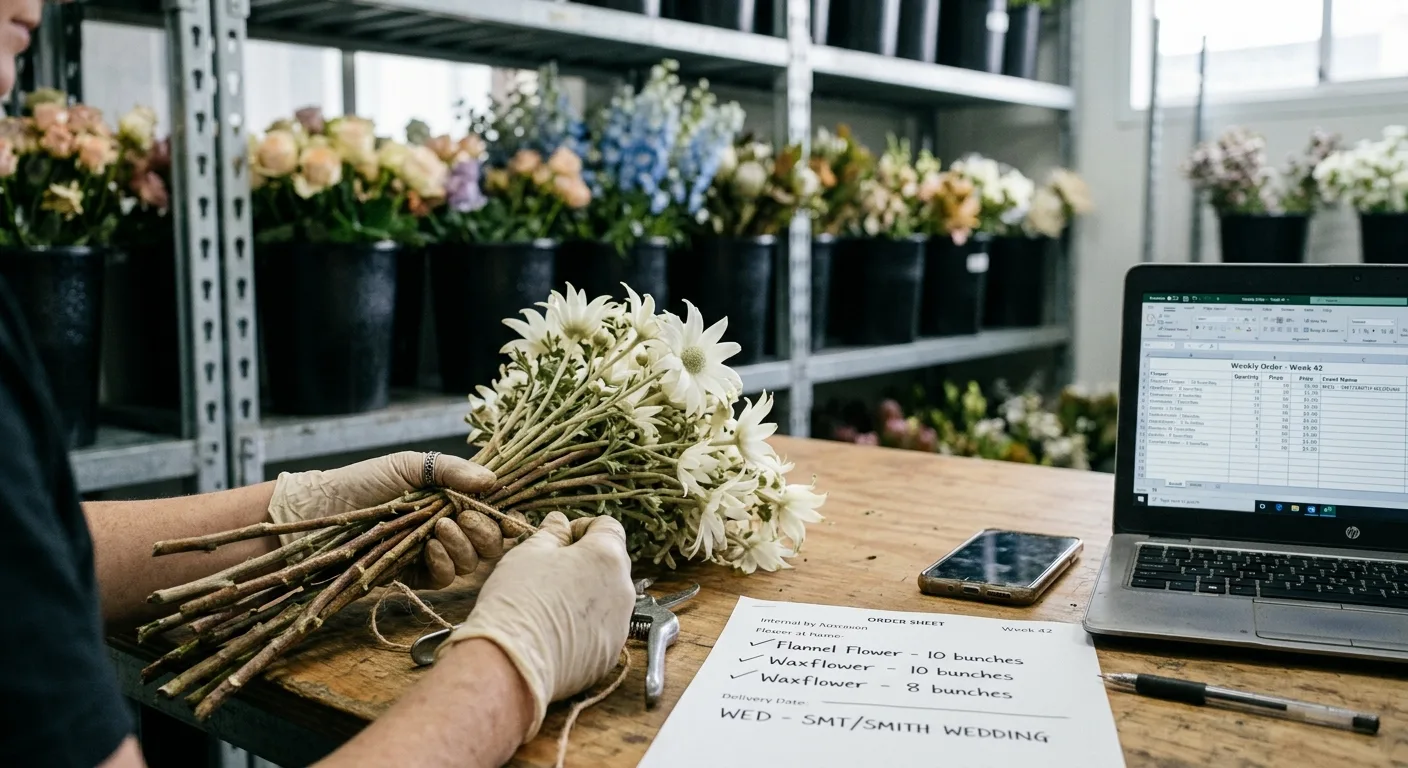
A weekly flower order planning cycle centres on a single, recurring workflow: on a fixed day, you review all upcoming events for the next planning window, compile all stem requirements, and place consolidated orders for the week.
That's it. The specifics vary by business size and supplier relationships, but the structure is consistent across every floristry operation that runs it well. For how the weekly cycle connects to planning individual large events, see planning a large wedding flower order.
The weekly planning session
This should happen on the same day every week. Monday or Tuesday works well for most florists - early enough in the week that any issues have time to be resolved before weekend events.
What happens in the planning session:
- Review all upcoming events within your order window (typically 1-2 weeks out depending on lead times)
- Confirm stem counts are finalised for each event - not estimated, not "mostly done"
- Aggregate stem requirements across all events - total stems per variety for the week
- Build the consolidated order - one order per supplier, covering all events
- Send orders with a clear confirmation deadline
The planning session should have a defined end point. Not "when I get to it." A scheduled block of time that happens every week.
The Aggregation Advantage
The single biggest operational benefit of weekly planning over per-event ordering is aggregation.
When you compile stem requirements across all events simultaneously, you get a complete picture of the week's needs. This has several practical effects:
Fewer deliveries. One consolidated delivery for the week is easier to receive, check, and process than three or four fragmented ones. It also reduces your freight costs.
Better availability information. When you ask your supplier for 200 stems of a given variety - rather than 50 three times over different days - the supply picture is clearer. They know what they're committing to. You know if it's achievable.
Pricing leverage. Volume orders place you in a different conversation with your supplier than fragmented ones. Consistency and predictability have real value in a wholesale relationship.
Overlap visibility. When you plan across events simultaneously, you can see when the same variety is required for multiple events in the same week. This lets you plan buffer quantities intelligently rather than building a separate buffer for each event in isolation.
Setting a Cut-Off Discipline
A cut-off is the point at which orders must be placed to guarantee delivery in the required window. Most florists know their supplier has cut-offs - they just don't always respect them consistently.
Part of building a weekly planning system is internalising cut-offs as fixed constraints, not guidelines.
Typical cut-off considerations:
- Standard season varieties: 3-4 days before delivery
- Imported or specialty varieties: 5-7 days or more
- High-demand periods (public holidays, Valentine's Day, spring wedding season): add at least 2 extra days
The implication: if you have a Friday delivery, your planning session needs to happen no later than Monday or Tuesday depending on what you're ordering. If you're still finalising stem counts on Thursday for a Friday event, you're outside most suppliers' windows for anything but the most common varieties.
Cut-off discipline is not about rigidity. It's about having enough lead time to resolve problems. A variety that's unavailable is manageable if you know on Monday. It's not manageable on Friday morning.
Managing the Planning Cycle Across Multiple Suppliers
Most event florists work with more than one supplier - a primary wholesaler for mainstream varieties, a specialist supplier for premium or unusual stems, possibly a direct grower for certain types.
A weekly planning system needs to account for each supplier's ordering window separately:
- Consolidated orders per supplier, not one big order split arbitrarily
- Different cut-offs for different suppliers - build your planning session around the earliest one
- A single record of what's been ordered where, so you're not double-ordering across suppliers
This coordination is manageable manually for two suppliers. At three or more, it becomes a significant overhead - and one of the stronger arguments for centralised planning tools that handle multi-supplier aggregation.
Reviewing Upcoming Events: What to Check
The planning session is not just a stem count exercise. Before building an order, confirm:
Is the event confirmed and unchanged? Client changes after an order is placed create re-work. Check for outstanding client decisions before finalising stem counts.
Are the stem counts actually finalised? "Mostly done" is not finished. An unfinished stem count that goes into an order will be wrong. If a count isn't ready, the event is not ready to order.
Are there any known supply constraints for this week? If you've had a recent conversation with your supplier about limited availability on a particular variety, factor that in before you commit to it for three events.
What are the delivery logistics? Each event may have a different delivery requirement. Build those into the consolidated order so your supplier knows what's going where on which day.
What Changes When the System Is Working
The difference between a reactive per-event approach and a functioning weekly planning system is not just operational efficiency - though that's real and significant. It's the quality of the week itself.
When planning is batched and structured:
- The supplier communication overhead drops to a manageable weekly cycle
- Confirmation chasing happens in one sweep, not scattered through the week
- Problems surface earlier, when there's still time to solve them
- Creative and client work can happen without constant interruption from order logistics
This is what event floristry should feel like at volume. The planning system is not the work - the design and the events are the work. The system exists to keep the planning from consuming all the space around them. For the broader picture of how operational systems support business growth, see how to scale a floristry business without hiring more admin staff.
Where Centralised Tools Support the Workflow
A weekly planning rhythm is achievable with disciplined spreadsheet management. Many florists run it well this way.
The limitation is that manually aggregating stem counts across multiple events, across multiple tabs, is error-prone and time-consuming. The more events in the planning window, the harder the aggregation step becomes.
A platform built around event-based order planning - where stem counts are held at the event level and rolled up automatically across the week - removes this bottleneck. StemCounts is designed specifically for this workflow: weekly planning across all events, automatic aggregation, consolidated supplier order submission, and confirmation tracking against the same record.
The workflow is the same. The manual aggregation step is gone.
Conclusion
A weekly flower order planning system is not a complicated thing to build. It requires a fixed planning day, a clear aggregation process, supplier cut-offs that are respected as constraints, and an explicit confirmation cycle.
What it replaces - fragmented per-event ordering, reactive chasing, uncertain confirmation status - is genuinely worse for your business and worse for your week.
The florists who run a tight weekly cycle don't do it because they're more organised by nature. They do it because they've experienced the alternative and made a different choice.
See it in action
Planning a week of event orders in StemCounts - every stem, every event, one view.
Spend your time on flowers, not spreadsheets.
Plan the week's flowers, for the shop or for a wedding, and send them to your wholesaler as one order or event by event.